
No products in the cart.
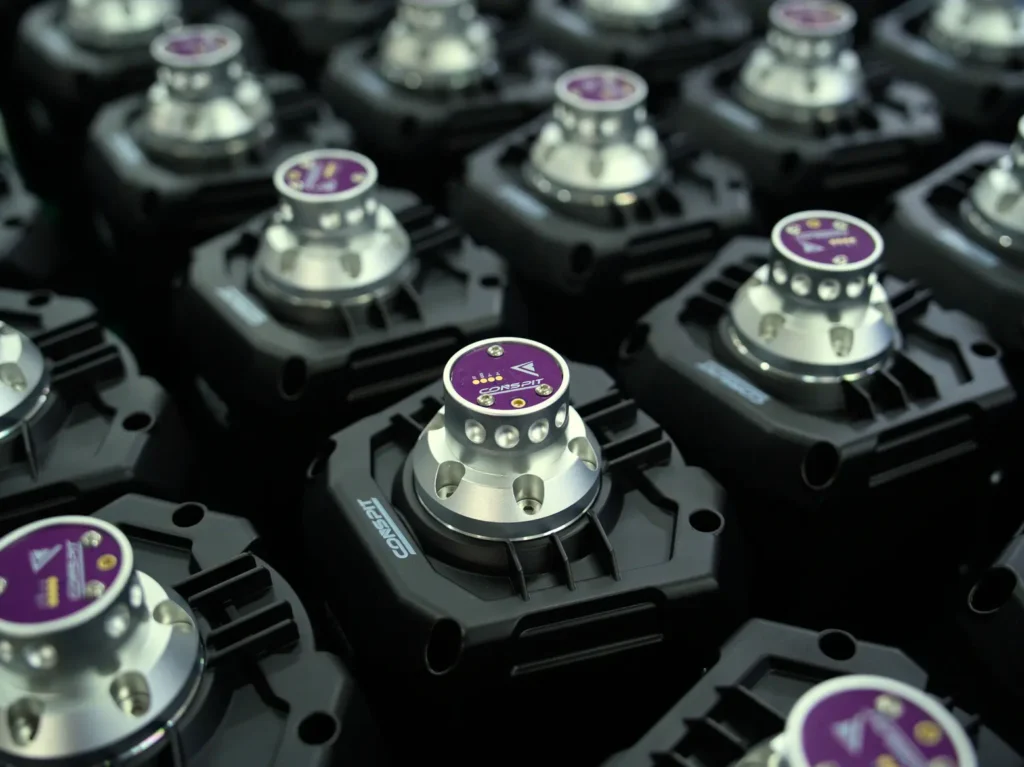
Wheelbase lineups have become crowded. MOZA Racing alone sells direct drive bases from 3.9 Nm to 25 Nm, SIMAGIC covers 9 Nm to 28 Nm across its Alpha EVO series, and CONSPIT‘s ARES series spans 8 Nm to 20 Nm. Reading spec sheets one at a time makes every base look impressive. Sorting them into torque tiers first, then comparing the technical differentiators inside each tier, turns a confusing lineup into a short list of two or three realistic candidates. That is the framework used below, and it is the same process system integrators such as NOX Gaming walk customers through before recommending a base.
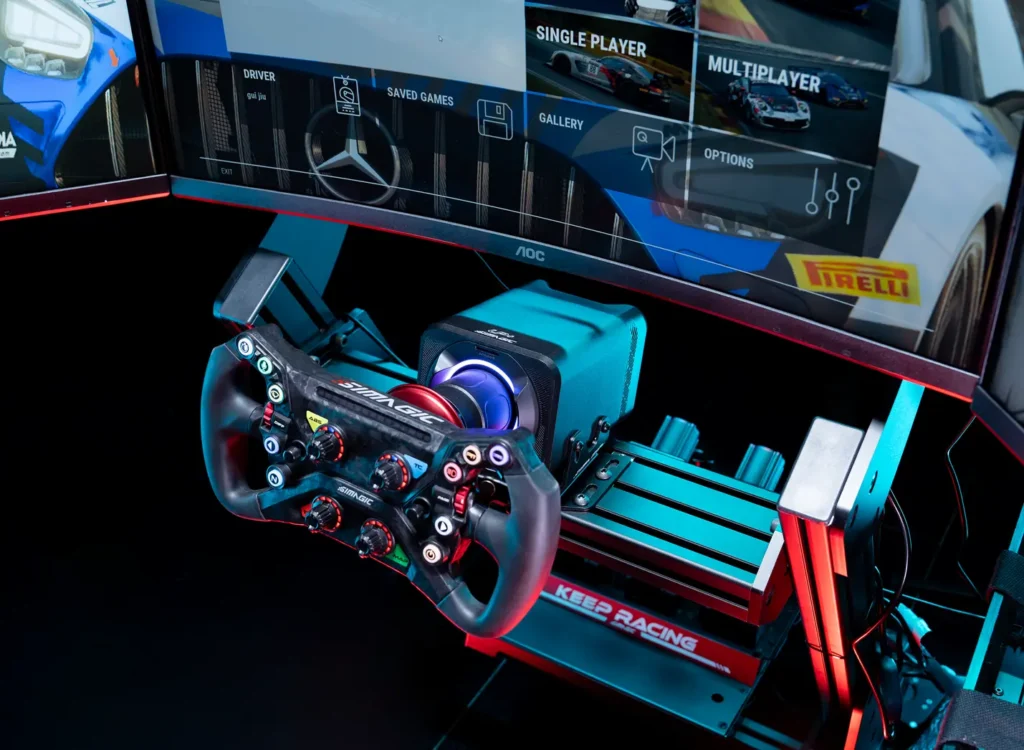
Torque, measured in newton-meters (Nm), is the rotational force the motor can apply to the steering shaft. It sets the ceiling for how heavy the wheel can feel and how hard the base can push back during curb strikes, spins, and crashes. The market has settled into four practical tiers.
| Tier | Torque range | Typical examples | Best suited for |
|---|---|---|---|
| Entry level | 4 to 9 Nm | MOZA R3 (3.9 Nm), MOZA R5 (5.5 Nm), MOZA R5 Pro (6 Nm), CONSPIT ARES APEX (8 Nm), SIMAGIC Alpha EVO Sport (9 Nm), MOZA R9 V3 (9 Nm) | First direct drive base, desk setups, casual and club-level racing |
| Mid-range | 9 to 13 Nm | MOZA R12 V2 (12 Nm), SIMAGIC Alpha EVO (12 Nm), CONSPIT ARES 12 (12 Nm) | Serious GT and road car racing, most league drivers |
| High end | 15 to 18 Nm | MOZA R16 V2 (16 Nm), SIMAGIC Alpha EVO Pro (18 Nm) | High-downforce cars, heavier wheel rims, drivers who run lower FFB gain for headroom |
| Flagship | 20 Nm and above | CONSPIT ARES 20 Platinum (20 Nm), MOZA R21 Ultra (21 Nm), MOZA R25 Ultra (25 Nm), SIMAGIC Alpha EVO Ultra (28 Nm) | Professional training, motorsport-adjacent use, maximum fidelity at low gain |
One packaging note on the bottom of the table: the MOZA R3, R5, and R5 Pro are sold as complete bundles rather than standalone bases. Each bundle pairs the wheelbase with a steering wheel and pedals, which makes them the fastest single-purchase path into direct drive. The R3 is also MOZA’s Xbox-licensed option; the R3 bundle for Xbox and PC works on both platforms, while the R3 PC-only bundle covers PC racers. From the R9 V3 upward, every base in the table is available on its own.
Two clarifications make this table more useful. First, peak torque and sustained torque are not the same number. Some motors hit their rated figure only in short bursts, then taper as heat builds. According to MOZA’s specifications, the R21 Ultra and R25 Ultra are rated for sustained output at their full 21 Nm and 25 Nm figures, and CONSPIT rates the ARES 12 and ARES 20 Platinum by holding torque, the continuous output the base sustains rather than a burst figure. Cooling design (covered below) is what makes sustained ratings possible. Second, more torque does not mean a better driving experience by default. Extra torque buys headroom: you can run the base at 50 to 60 percent gain and keep full detail without clipping, the point where the game requests more force than the motor can deliver.
For most drivers, 9 to 13 Nm is the sweet spot. A real GT3 or touring car with power steering produces steering loads that a well-tuned 12 Nm base represents convincingly, and few drivers run flagship bases at full strength for more than a stint anyway. Choose the entry tier (4 to 9 Nm) if you race on a desk, race casually, or are testing whether direct drive is for you; a complete kit like the MOZA R5 Pro bundle covers base, wheel, and pedals in one box. Move to the high-end tier (15 to 18 Nm) if you race high-downforce open wheelers, use heavy wheel rims with displays and magnetic shifters, or want to run low gain for maximum dynamic range. Flagship bases at 20 Nm and above make sense for professional or semi-professional training and for drivers who already know they want maximum headroom.
Torque above roughly 15 Nm is a physical safety consideration, not just a spec. A flagship base can wrench the wheel out of relaxed hands during a crash. Brands include safety features for this reason: MOZA and SIMAGIC flagship bases support hands-off detection, and CONSPIT sells a dedicated CES E-Stop emergency switch for its ARES bases. Keep thumbs out of the wheel spokes, the same rule real race drivers follow.
The encoder is the sensor that reports the steering shaft position to the PC. Its resolution, stated in bits, determines how finely the base can resolve your inputs and its own corrections. A 15-bit encoder resolves 32,768 positions per revolution, a 21-bit encoder resolves 2,097,152, and a 23-bit encoder resolves 8,388,608. That precision shows up as cleaner self-aligning torque, smoother countersteer catches, and more distinct road texture at small steering angles.
Encoder resolution is a useful tie-breaker inside a tier, including at entry level. According to MOZA’s specifications, the R3 and R5 use 15-bit encoders, while the R5 Pro jumps to a 21-bit magnetic encoder despite sitting only 0.5 Nm above the R5. That encoder step, more than the torque step, is what separates the two bundles. From the R9 V3 up to the R25 Ultra, MOZA fits 21-bit encoders across the lineup, and SIMAGIC‘s Alpha EVO series also uses 21-bit encoders paired with a 20 kHz response rate. CONSPIT splits its lineup: the ARES APEX uses a 21-bit magnetic encoder, while the ARES 12 and ARES 20 Platinum step up to 23-bit optical encoders, currently the highest resolution in this comparison. Encoder type matters less than resolution in practice, but optical encoders are immune to magnetic interference by design. When two bases share the same torque figure, compare encoder bit depth, then the force feedback processing rate (how many times per second the base recalculates output torque), then USB polling rate, where 1000 Hz is the current standard.
Electric motors lose torque as they heat up, and the electronics driving them throttle output to protect themselves. That makes cooling a real differentiator in endurance races and long practice sessions, exactly when consistent force feedback matters most.
Wheelbases handle heat in two ways. Passive cooling relies on the aluminum housing acting as a heatsink. It is silent and has no moving parts, and it works fine for lower-torque bases run at moderate gain; the R3 and R5 bundles manage heat this way with intelligent temperature control. Active cooling adds a fan and, in better implementations, real-time temperature monitoring that manages output before throttling becomes noticeable. MOZA uses intelligent active cooling from the R9 V3 and R12 V2 upward, the flagship SIMAGIC Alpha EVO Ultra pairs active cooling with its 28 Nm motor, and the CONSPIT ARES 20 Platinum adds active cooling to hold its 20 Nm constant torque rating. According to CONSPIT’s specifications, even the passively cooled ARES APEX uses real-time temperature monitoring to keep output consistent through endurance sessions. When comparing two bases in the same tier, an actively cooled base run at 70 percent gain will usually hold its output more consistently over a two-hour session than a passively cooled base run near its limit.
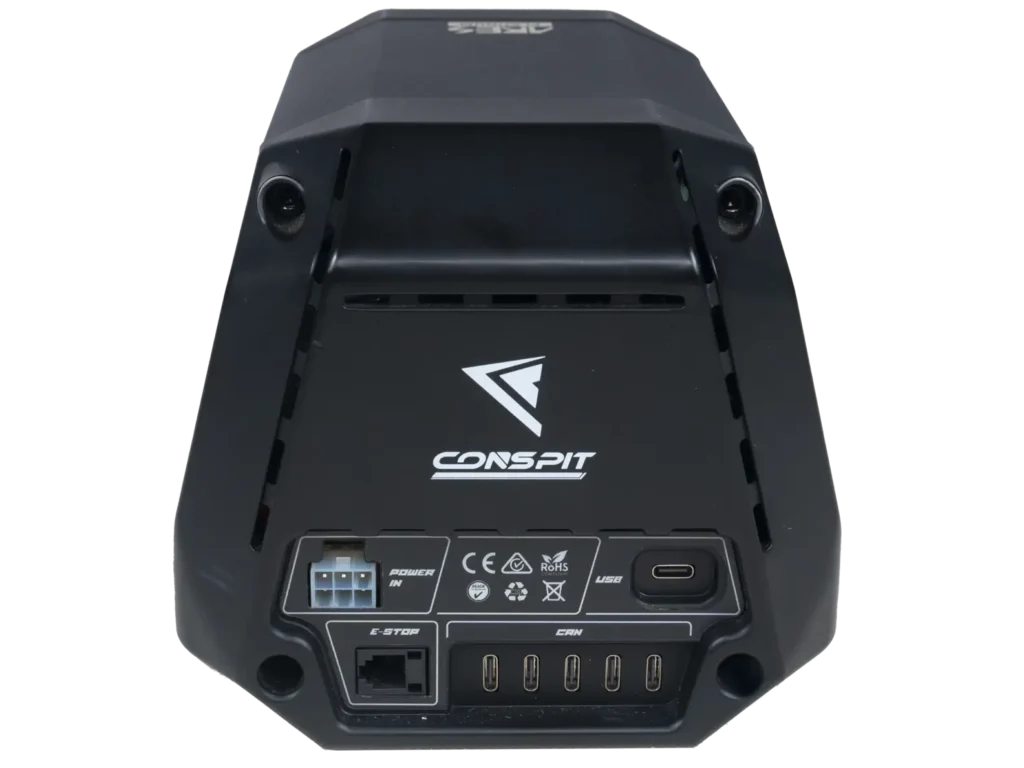
Cogging is the notchy, detent-like feel some motors produce as the rotor magnets pass the stator teeth. It corrupts fine detail, especially at low forces around center. Manufacturers fight cogging with skewed-pole motor designs (MOZA uses a slanted-pole layout in the R12 V2 and R16 V2, and CONSPIT builds its entire ARES series around skew-pole motors) or with motor designs marketed as zero cogging, which MOZA claims for the R25 Ultra‘s flat-wire motor and SIMAGIC claims for the Alpha EVO Ultra.
Rotor inertia and slew rate matter just as much. A heavy rotor resists rapid direction changes, which dulls fast transitions like curb strikes and slides; SIMAGIC builds its Alpha EVO series around an ultra-low inertia rotor for this reason. Slew rate is how fast the motor can change its output force, and it is one of the few smoothness-adjacent specs published as a number: according to CONSPIT’s specifications, the ARES APEX reaches a maximum torque change rate of 4 Nm per millisecond. Neither cogging nor inertia appears as a single comparable figure on most spec sheets, so look for the design language instead: skewed or slanted poles, zero-cogging claims, flat-wire windings, low-inertia rotor construction, and published slew rates all signal that the manufacturer engineered for smoothness rather than just a headline torque figure.
A wheelbase can only feel as good as whatever it is bolted to. Flex in the mounting eats force feedback detail and, at higher torque, becomes a structural problem. Use torque tier as a mounting guide.
Racing discipline shifts the priorities inside a tier. GT and touring car drivers benefit most from mid-range torque with strong low-force detail, since these cars communicate through subtle weight transfer and tire load. Formula drivers push toward the high-end tier because high-downforce cars generate heavier steering loads and reward extra headroom. Drift and rally drivers should weight motor smoothness and slew rate above raw torque, because catching slides depends on the base reversing force quickly and cleanly. Console racers have a shorter list: the Xbox-licensed MOZA R3 bundle is the direct drive entry point for Xbox Series X|S, while everything else in this comparison is PC hardware. Truck and casual road drivers can stay in the entry tier and spend the difference on pedals, which improve lap times more per dollar than extra wheelbase torque once you pass 9 Nm.
A wheelbase is the anchor purchase of a sim rig, so compare ecosystems, not just bases. Three questions matter. First, which steering wheels attach to it? MOZA bases use MOZA’s quick release system across the lineup, from the R3 bundle’s wheel up to the R25 Ultra, SIMAGIC’s Alpha EVO series supports the company’s QR50, QR70, and QR-A quick releases, and CONSPIT’s ARES bases use the CDR quick release, so wheels carry over when you upgrade the base within the same brand. Second, does the base act as a hub? Many current bases offer ports for pedals, shifters, handbrakes, and dashboards, which cuts USB clutter and keeps peripherals working through one software suite (MOZA Pit House for MOZA, SimPro Manager for SIMAGIC, CONSPIT Link 2.0 for CONSPIT). Third, will your mounting survive the next base? Buying a rig rated for 20 Nm today costs less than replacing a desk setup twice.
The most common upgrade mistake is buying at the very bottom of a tier while planning to move up within a year. If you already know you will want more headroom, buying one tier higher once is cheaper than buying twice. The bundle-only entry bases are built with this in mind: pedals and wheels from the R5 and R5 Pro bundles carry over to a stronger MOZA base later. NOX Gaming ships MOZA, SIMAGIC, and CONSPIT hardware across Canada and the US, and all three ecosystems are built so gear bought today keeps working after the base upgrade.
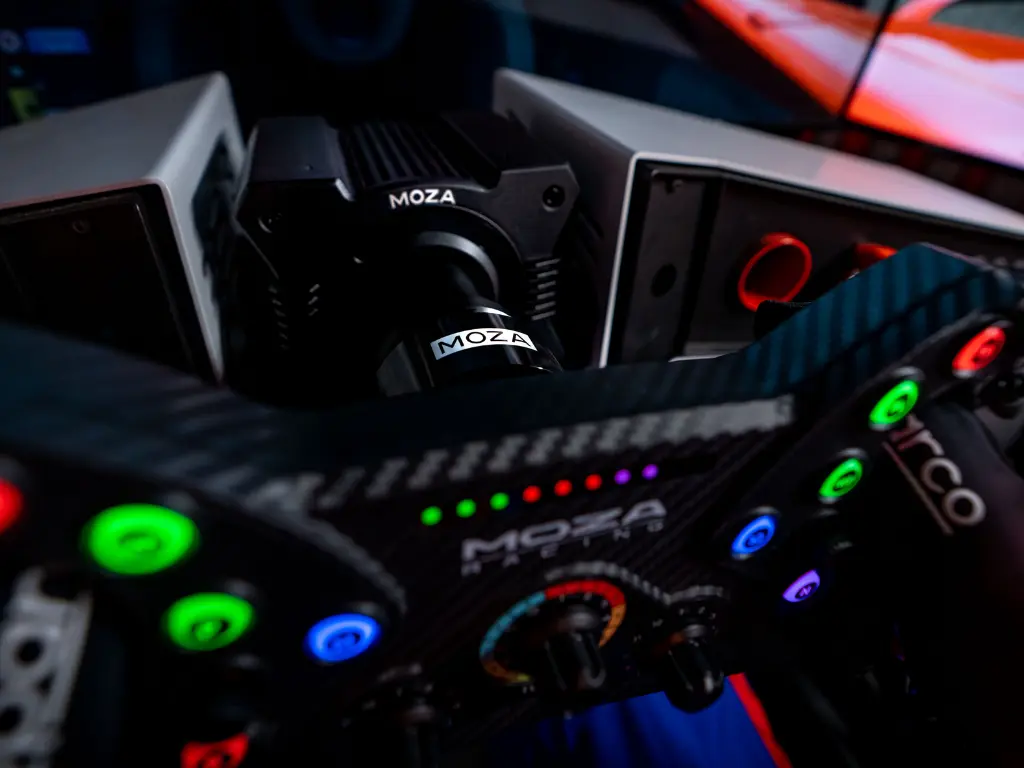
Applied to a real lineup, the framework produces recommendations like these. A driver racing GT3 in iRacing on an aluminum profile rig, planning to stay in GT cars, lands on a 12 Nm base with a high-resolution encoder, such as the MOZA R12 V2, SIMAGIC Alpha EVO 12 Nm, or the 23-bit CONSPIT ARES 12. A newcomer on a solid desk who wants direct drive without committing to a cockpit fits an entry-tier setup with a matching clamp, such as the MOZA R5 Pro bundle, the standalone MOZA R9 V3, or the CONSPIT ARES APEX. A driver running open wheelers and endurance events who wants to race at low gain with full detail belongs in the flagship tier, where the SIMAGIC Alpha EVO Ultra‘s 28 Nm low-inertia motor, MOZA’s sustained-torque R21 Ultra and R25 Ultra, and the actively cooled CONSPIT ARES 20 Platinum are the candidates. Same four layers each time: tier, signal, cooling, fit.
Available at NOX Gaming
NOX Gaming is an authorized Canadian distributor for MOZA Racing, SIMAGIC, and CONSPIT direct drive wheelbases, from 3.9 Nm entry bundles to 28 Nm flagships, shipped across Canada and the US.
Full manufacturer specifications are published by MOZA Racing, SIMAGIC, and CONSPIT.
Most sim racers are well served by 9 to 13 Nm of torque. That range represents GT and road car steering loads convincingly while leaving headroom so the force feedback signal does not clip. Go higher, 15 Nm and up, if you race high-downforce formula cars, use heavy wheel rims, or want to run low gain for maximum detail.
Yes, a 5 to 6 Nm direct drive base such as the MOZA R5 or R5 Pro delivers clean, detailed force feedback in iRacing and ACC, and it is a large step up from belt-driven wheels. The trade-off is headroom: at 5 Nm you will run the base near its limit, so peak forces like heavy curb strikes compress together. It is a strong entry point, not a limitation for learning to race fast.
Console support requires manufacturer licensing per platform, so most direct drive bases are PC only. In this comparison, the exception is the MOZA R3, an Xbox-licensed bundle that works on Xbox Series X|S, Xbox One, and PC. Check platform licensing on the manufacturer’s spec sheet before buying any base for console use.
Encoder resolution, stated in bits, is how finely the base tracks steering position. A 15-bit encoder resolves 32,768 positions per revolution, a 21-bit encoder resolves 2,097,152, and a 23-bit encoder, like the optical units in CONSPIT’s ARES 12 and ARES 20 Platinum, resolves 8,388,608. Higher resolution translates to smoother self-centering and finer road texture.
Not all of them, but active cooling helps sustain torque during long sessions. Motors lose output as heat builds, and passively cooled bases run near their limit can taper during endurance races. An actively cooled base with temperature monitoring holds its output more consistently, which is why sustained and holding torque ratings usually come with active cooling.
Yes, up to roughly 9 Nm, using a purpose-built clamp such as MOZA’s steel table clamp, SIMAGIC’s T-LOC, or CONSPIT’s ARES APEX desk clamp mount. The MOZA R5 and R5 Pro bundles include a table clamp in the box. The desk needs to be genuinely rigid, because flex blurs force feedback detail. Above about 13 Nm, a dedicated stand or cockpit stops being optional.
Cogging is a notchy resistance some electric motors produce as the rotor magnets pass the stator teeth, and it corrupts fine force feedback detail near center. Manufacturers reduce it with skewed-pole motor layouts or eliminate it with zero-cogging motor designs. When comparing bases with equal torque, low cogging and low rotor inertia are what make one feel smoother than the other.
Buying one tier above your current need is usually cheaper than upgrading twice, because the wheelbase anchors the whole rig. Extra torque also lets you run lower gain, which preserves detail and avoids clipping. The exception is desk setups: there is little point buying an 18 Nm base you cannot mount rigidly enough to use.


